
The Roadmap Isn’t Broken. We’re Just Asking It to Do a Job It Was Never Designed For
One thing that jumps out from this year’s eCommerce Insights Report is that most teams know what they want to achieve next year, but very few know how they’re going to get there.

Written by:
Date:
Reading time:
Sixty percent say their roadmap is “somewhat defined.” Another 20% say it needs refinement.
So only one in five businesses is going into 2026 with something that genuinely resembles a plan.
That’s not a lack of ambition. It’s the result of using the wrong tool for the job.
We keep treating eCommerce roadmaps like backlogs but eCommerce isn’t a sequence of tasks - it’s a network of interdependencies.
Look at what teams are balancing in the current market:
Eight marketing channels
Acquisition costs climbing
AI embedding into workflows
Infrastructure strain
Performance management
And the usual mix of CRO, UX, content, merchandising, trading, integrations and operational noise.
That isn’t a roadmap. It’s an ecosystem, and ecosystems don’t respond well to linear plans.
A roadmap written like a backlog will always feel too small for the reality it’s meant to hold.
eCommerce isn’t built in straight lines - it sits at the intersection of marketing, product, data, engineering, operations, content, logistics, compliance and commercial pressures.
All moving at their own speed. All shifting with their own constraints. None of them waiting for your Gantt chart.
This is why so many roadmaps drift, not because people are disorganised, but because the structure itself is too rigid for the reality it’s meant to support.
Callum Brown puts it neatly in the report: roadmaps often get overlooked not because they’re unimportant, but because organisations don’t really know how to build them. He’s right.
If your roadmap doesn’t reflect:
commercial priorities
performance constraints
customer friction
data limitations
tech debt
operational realities
channel volatility
…then it isn’t a roadmap. It’s a wishlist with dates attached.
What the high performers understand, even if they don’t explicitly say it, is that roadmaps have to be living systems. They need to adapt as behaviours shift, channels evolve, costs rise, AI unlocks new options, and bottlenecks appear across the stack.
So the real question isn’t “What features are we delivering next quarter?” It’s: “What business are we trying to become, and what’s the sequence of decisions that gets us there?”
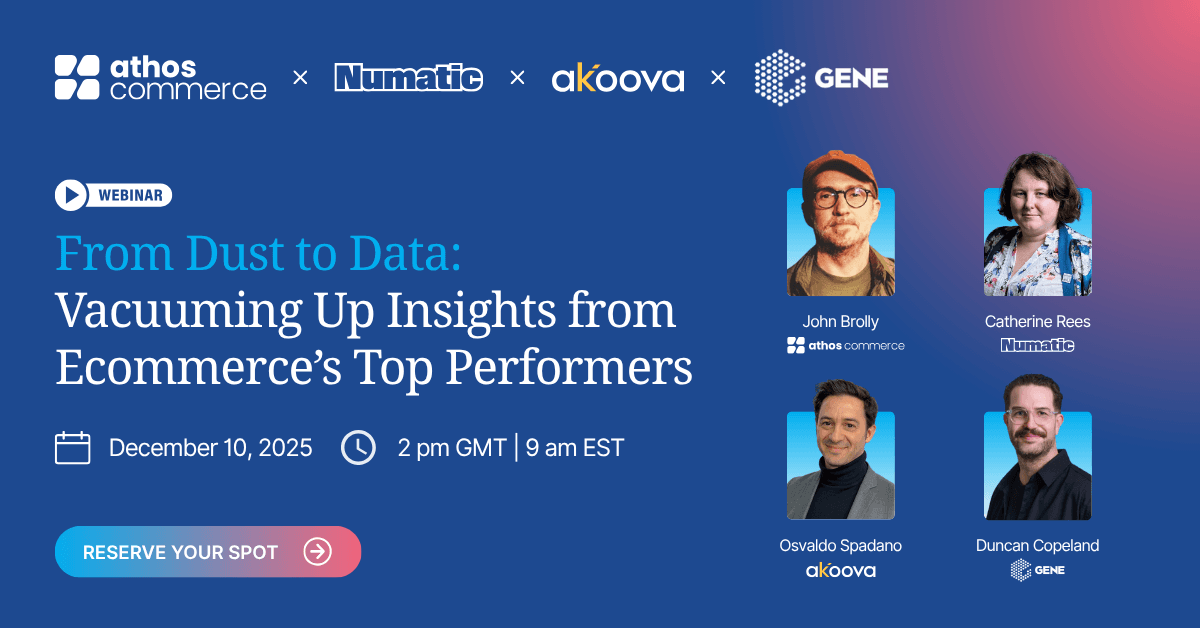
On 10 December, we’re digging into that with Akoova, Athos and Numatic. Not just how to fill a roadmap, but how to think about roadmapping in a world where eCommerce has stopped being feature-first and started being system-first.
If 2024 was about keeping the wheels on, and 2025 is about moving with intent, then 2026 becomes the point where intent meets capability.
Momentum doesn’t come from shipping faster. It comes from having a foundation that can actually support the ambition placed on it - architecture, data, customer insight, operations, aligned and coherent.
2026 won’t reward speed alone, but iIt will reward teams who spent 2025 building something that can respond, adapt and scale.
If you want to see what that looks like in practice, join the webinar.
Related Blog Posts



Resources


© 2026 Gene Commerce Ltd